Burr vs Blade Grinder: Which Should You Choose?
Here is the uncomfortable truth nobody wants to hear after dropping serious cash on a shiny espresso machine: that little spinning-blade gadget on your counter is quietly sabotaging every cup. You bought good beans. You dialed in your water. And then you handed it all over to a glorified propeller. Rude, honestly.
So let’s settle the burr vs blade grinder debate once and for all. By the time you finish reading, you’ll know exactly how each one works, why one of them produces coffee that actually tastes like the roaster intended, and which one deserves a spot on your counter. Spoiler: I have opinions. Useful ones.
How a Blade Grinder Actually Works
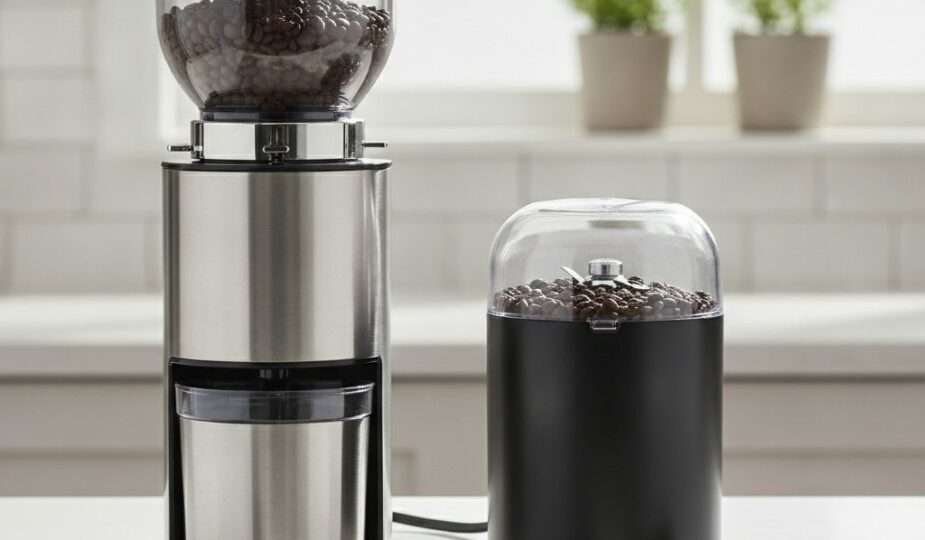
A blade grinder is a tiny spinning knife in a cup. You press the button, the blade whips around at high speed, and it chops whatever beans happen to be in its path. The longer you hold the button, the smaller the pieces get. That’s the entire mechanism. It’s the same idea as a mini food processor, and it treats your coffee with roughly the same finesse.
The problem is that chopping is random. The blade hits some beans constantly and never touches others. You end up with a chaotic mix: fine powder, medium chunks, and big stubborn boulders, all in the same batch. There’s no setting for “medium grind.” There’s only “how long can I keep my finger on this button before I give up.”
How a Burr Grinder Actually Works
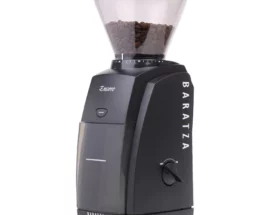
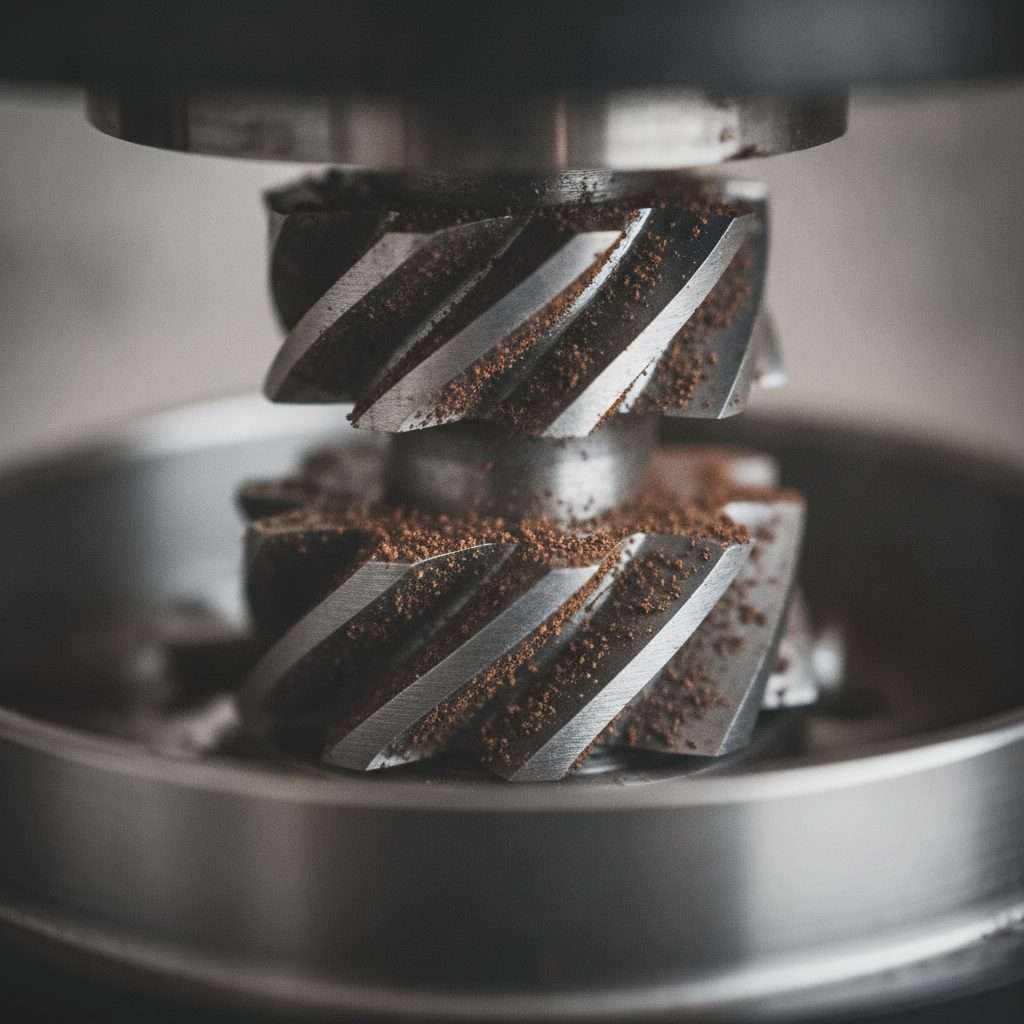
A burr grinder is a different beast entirely. Instead of one chopping blade, it uses two abrasive surfaces, the burrs, with a precise gap between them. Beans get pulled into that gap and crushed down to a uniform size, then fall out the bottom once they’re small enough to pass through. Adjust the gap, and you adjust the grind size. Wider gap, coarser grind. Tighter gap, finer grind.
This is the whole game. Because every particle has to squeeze through the same gap, you get consistent, repeatable results. You’re not eyeballing seconds on a stopwatch. You’re setting a number and getting the same grind every single time. That repeatability is what makes a burr grinder the engine behind nearly every grinder worth buying.
Consistency: Uniform vs Random (This Is the Whole Ballgame)
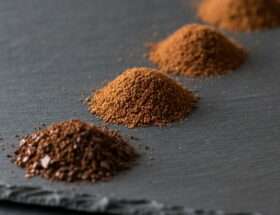
Here’s why grind consistency matters so much. When you brew, water pulls flavor out of coffee at a rate that depends on particle size. Small particles give up their flavor fast. Big particles give it up slowly. Get them all roughly the same size, and they extract together, in harmony, like a well-rehearsed choir.
Throw in a blade grinder’s mess of powder and boulders, and that harmony falls apart. The fine powder over-extracts and turns bitter and harsh. The boulders under-extract and taste sour, grassy, and weak. Both happen in the same cup at the same time. You’re tasting two opposite flaws at once, which is exactly why blade-ground coffee so often lands as muddy, ashy, and just… off.
Burrs fix this by giving you one fairly tight band of particle sizes. Everything extracts at a similar rate, and suddenly the cup tastes balanced. If you want to nerd out on what each size is good for, our coffee grind size chart breaks down exactly which grind suits which brew method.
Heat: Why Blades Cook Your Coffee
Blade grinders spin fast, and fast spinning creates friction, and friction creates heat. Run one long enough to get an espresso-fine grind and you can actually warm the grounds noticeably. That heat scorches off the delicate aromatic compounds, the very things that make a Kenyan taste like blackcurrant or an Ethiopian taste like blueberry. You paid for those notes. The blade burns them off before they reach your cup.
Burr grinders crush rather than slash, usually at lower speeds, so they generate far less heat and preserve those volatile aromatics. Your beans arrive in the cup tasting like the roaster intended instead of like a faint memory of themselves. If you’ve invested in good beans, protect them. (Our guide on how to properly store coffee beans covers the other half of that equation.)
Burr vs Blade Grinder: Side-by-Side
| Factor | Burr Grinder | Blade Grinder |
|---|---|---|
| Mechanism | Crushes beans between two burrs | Chops beans with a spinning blade |
| Consistency | Uniform particle size | Random mix of powder and boulders |
| Grind control | Precise, repeatable settings | Timing the button (good luck) |
| Heat | Low; preserves aromatics | High; can scorch delicate notes |
| Best for | Espresso, pour over, French press, all of it | Spices, in a pinch |
| Typical price | $40 to $1,000+ | $15 to $30 |
| Cup quality | Clean, balanced, expressive | Muddy, uneven, bitter-and-sour |
Dialing In: The Thing Blades Simply Can’t Do
“Dialing in” means adjusting your grind to hit a target, then keeping it there. It’s the single most powerful lever you have over flavor, and it’s a lever a blade grinder doesn’t even have.
Say your espresso runs too fast and tastes sour and thin. The fix is to grind finer to slow the water down. With a burr grinder, you nudge the dial one notch and pull again. With a blade grinder, you… hold the button a little longer next time and pray. There’s no repeatability, so there’s nothing to dial. Here’s the burr workflow for espresso:
- Pick a starting recipe, for example 18 grams of coffee in, 36 grams of espresso out, in 25 to 30 seconds.
- Pull a shot and taste it. Too fast and sour means under-extracted. Too slow and bitter means over-extracted.
- Adjust the grind one step finer (to slow it down) or coarser (to speed it up).
- Pull again and repeat until your time and taste land where you want them.
That whole loop is impossible without consistent, adjustable grinding. Our deep dives on how to dial in espresso grind and the broader coffee-to-water ratio will take you the rest of the way. A scale helps too, which is why we’re nerds about coffee scales.
Conical vs Flat Burrs: Choosing Your Burr Geometry
Once you’re shopping burr grinders, you’ll hit a second fork: conical or flat. Both crush rather than chop, so both blow blades out of the water. They just shape the cup a little differently.
Conical Burrs
A cone-shaped burr nests inside a ringed outer burr, and beans fall through the gap by gravity. Conical burrs tend to run quieter and cooler, cost less, and are more forgiving when you dial in. The trade-off is a slightly wider spread of particle sizes, which often reads in the cup as a rounder, fuller body with a heavier mouthfeel. Great for espresso lovers who want that classic, syrupy texture.
Flat Burrs
Two flat, ring-shaped burrs sit parallel and fling grounds outward by speed. Flat burrs generally produce a more uniform grind, which translates to more clarity and separation of flavor notes in the cup. The catch: they tend to cost more, can be louder, and can run hotter without good ventilation. They’re the darling of espresso obsessives chasing precise, repeatable, flavor-forward shots.
| Trait | Conical Burrs | Flat Burrs |
|---|---|---|
| Cup character | Rounder body, fuller mouthfeel | More clarity, distinct notes |
| Consistency | Very good | Excellent |
| Noise & heat | Quieter, cooler | Can be louder, warmer |
| Forgiveness | Easier to dial in | More demanding |
| Price | Usually lower | Usually higher |
Neither is objectively “better.” It’s a flavor preference. Body and comfort? Conical. Clarity and precision? Flat. Either one is a massive upgrade over a blade, so don’t let this choice paralyze you.
Price: What You’ll Actually Spend
Blade grinders run roughly $15 to $30. Burr grinders start around $40 for a decent entry-level model and climb past $1,000 for high-end gear with big flat burrs and stepless adjustment. A solid hand-crank burr grinder in the $50 to $120 range will outperform any blade grinder on the planet, so good coffee does not require a second mortgage.
- $40 to $80: Entry electric or quality manual burr grinder. Great for pour over and French press.
- $100 to $300: Stepped or stepless burrs that handle espresso reliably.
- $300 and up: Single-dial precision, faster grinding, premium burrs for the truly obsessed.
Why the Grinder Matters More Than the Machine
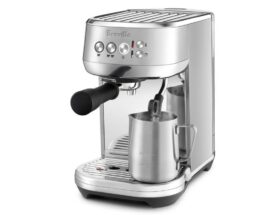
Here’s the hill I’ll die on: if you’ve got a fixed budget, spend it on the grinder, not the brewer. A fancy espresso machine fed by a blade grinder is a sports car running on lawnmower fuel. But a modest brewer paired with a good burr grinder? That makes genuinely excellent coffee.
The grinder is the foundation everything else sits on. No machine, no water quality tweak, and no recipe can rescue coffee that was ground unevenly to begin with. Get the grind right and the whole rest of your setup, from a pour over to a full home espresso rig, finally gets to show off.
My Recommendation
Buy a burr grinder. That’s it. That’s the recommendation. There’s no brew method, no budget, and no skill level where a blade grinder is the right call for coffee. (Spices? Sure, keep the blade for that.)
- Pour over or French press, tight budget: A quality manual conical burr grinder. Cheap, quiet, excellent.
- Mixed brewing, want convenience: A mid-range electric conical burr grinder.
- Espresso-focused, chasing clarity: A flat-burr grinder with fine, repeatable adjustment.
Frequently Asked Questions
Can I use a blade grinder for espresso?
Realistically, no. Espresso demands a fine, extremely consistent grind so the machine can build proper pressure. A blade grinder can’t produce that uniformity or be adjusted precisely, so shots come out gushing or choked and taste harsh. You need a burr grinder, ideally one built to handle the fine end. Start with our home espresso guide.
Is a hand grinder or an electric grinder better?
For grind quality, what matters is that it has burrs, not whether you crank it or plug it in. A good manual burr grinder makes excellent coffee for less money, with a little arm work. Electric grinders win on speed and convenience, especially for espresso or larger batches. Pick based on your patience and budget.
Do I really need to upgrade if my coffee tastes fine?
If you’re happy, you’re happy, and that’s allowed. But most people are stunned by the jump after switching to burrs, more sweetness, more clarity, far less bitterness. If your coffee tastes muddy or harsh no matter what you do, your blade grinder is the likeliest culprit. Compare it against fresh good beans and judge for yourself.
How long do burr grinders last?
Burrs are wear parts, but they last a long time. Steel burrs in a home grinder can stay sharp through hundreds of pounds of coffee, often many years of daily brewing. Most quality grinders let you replace the burrs when they finally dull, so the machine outlives the cutting surfaces.
Bottom line: the grinder is where great coffee is won or lost. Treat yourself to burrs, dial it in, and let those good beans finally taste like the price you paid for them. Your morning cup is about to get a serious glow-up, and honestly, you’ve earned it.