Coffee Grind Size Chart: Match Your Grind to Your Brewer
Here’s the uncomfortable truth: you can buy gorgeous beans, dial in the perfect water temperature, and weigh everything to the gram, and still pull a cup that tastes like a wet cardboard box. The culprit is almost always sitting right there in your grinder. Grind size is the single biggest lever you control, and most people are yanking the wrong one.
Good news, because you found the right page. By the end of this, you’ll know exactly how coarse or fine to grind for every brewer in your kitchen, what each grind should actually look and feel like, and why getting it right turns a sad cup into the kind of coffee you’d brag about. Let’s get into it.
Why Grind Size Drives Everything
Brewing coffee is really just water dissolving flavor out of ground beans. We call that extraction, and grind size controls how fast it happens. Smaller particles have more surface area touching the water, so they give up their goodies quickly. Bigger particles take their sweet time.
Here’s the part nobody tells you. Extraction happens in stages: fruity acids release first, then the sweet sugars, then the bitter, mouth-drying compounds last. The whole game is stopping at “sweet” before you hit “bitter.”
- Grind too fine for your method and water lingers too long. You blow past sweet into bitter, harsh, and astringent. That’s over-extraction.
- Grind too coarse and water rushes through before it does its job. You’re stuck at sour, thin, and weak. That’s under-extraction.
So grind is your brake pedal. A long, slow brew like cold brew needs coarse grounds to avoid over-extracting over many hours. A fast brew like espresso needs fine grounds to extract enough in 25 seconds. Match the grind to the contact time and you’re golden. For more on chasing down that ideal flavor window, our guide on adjusting coffee strength pairs perfectly with this one.
The Coffee Grind Size Chart
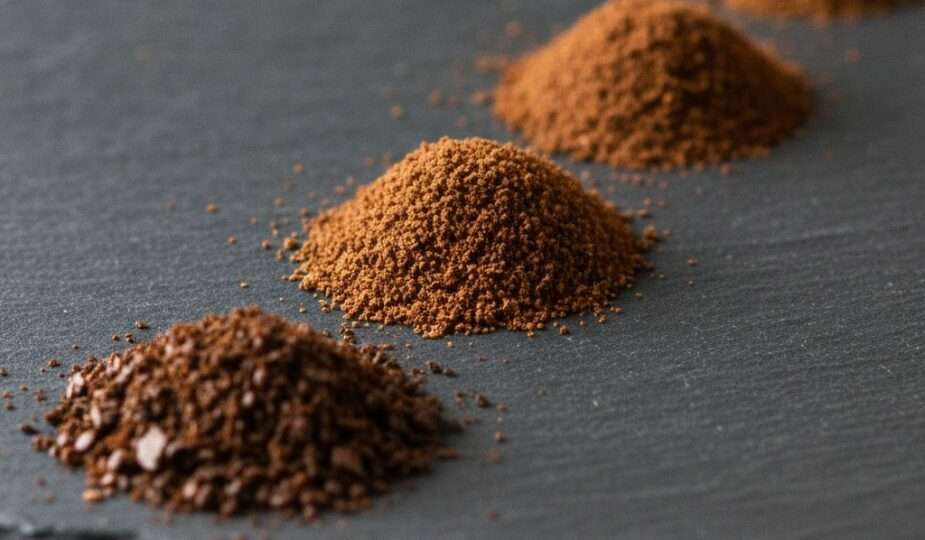
This is the cheat sheet to bookmark. The micron ranges are approximate, because every grinder and every bean behaves a little differently, but they’ll get you in the right neighborhood fast. The texture references are your real-world gut check when you don’t have a fancy sizing tool (read: never).
| Grind Level | Looks/Feels Like | Approx. Microns | Best For |
|---|---|---|---|
| Extra Coarse | Peppercorns | 1,000–1,400 | Cold brew, cowboy coffee |
| Coarse | Sea salt / kosher salt | 700–1,000 | French press, percolator |
| Medium-Coarse | Rough sand | 600–800 | Chemex, Clever Dripper |
| Medium | Beach sand | 400–700 | Drip / automatic machines, flat-bottom filters |
| Medium-Fine | Fine sand / table salt | 300–500 | Pour-over (V60), AeroPress |
| Fine | Powdered sugar / flour | 180–380 | Espresso, Moka pot |
| Extra Fine | Powder / cocoa | 40–220 | Turkish coffee (ibrik) |
Notice the ranges overlap a little? That’s intentional. Grind size isn’t a single magic number, it’s a sweet spot you nudge toward based on taste. Sour cup, go finer. Bitter cup, go coarser. Keep your coffee-to-water ratio steady while you experiment so you’re only changing one thing at a time.
Grind Size by Brewing Method
Extra Coarse: Cold Brew
Think chunky peppercorns. Cold brew steeps for 12 to 24 hours, so anything finer turns into a muddy, over-extracted sludge that’s a nightmare to filter. Extra coarse keeps it smooth, sweet, and clean. Cowboy coffee (grounds boiled straight in a pot) wants this too, so the grounds sink instead of floating into your teeth.
Coarse: French Press
Sea salt territory, roughly 700 to 1,000 microns. The metal mesh on a French press lets fine particles slip through, so too fine means a gritty, silty cup and a bitter finish. Coarse grounds give you that signature full, rich body without the sludge. Steep for about four minutes, then press. Our full French press guide walks through the timing and ratios.
Medium-Coarse: Chemex
The Chemex uses thick paper filters that slow the flow way down, so it likes its grounds a touch coarser than a standard pour-over, like rough, gritty sand. Too fine and the brew chokes, dripping forever and turning bitter. Get it right and the Chemex rewards you with one of the cleanest, brightest cups out there.
Medium: Drip / Automatic
Your everyday automatic coffee maker is happiest with a medium grind, the texture of regular beach sand. This is the most forgiving zone, which is why pre-ground supermarket coffee defaults here. If your machine’s brew tastes flat, freshly ground medium beans are the single biggest upgrade you can make. Pair it with a solid coffee maker and you’re set.
Medium-Fine: Pour-Over and AeroPress
A cone pour-over like the Hario V60 wants medium-fine, somewhere between fine sand and table salt. It drains faster than a Chemex, so it needs a bit more surface area to extract fully in two to three minutes. The AeroPress is a chameleon, but medium-fine is the reliable starting point. Dial it in with our pour-over guide.
Fine: Espresso and Moka Pot
Espresso forces pressurized water through a packed puck in about 25 to 30 seconds, so it demands a fine grind, like powdered sugar, to build the resistance that creates pressure and crema. This is the fussiest grind on the chart: a tiny adjustment swings your shot from sour gusher to bitter trickle. That’s why dialing in your espresso grind and learning to make espresso at home are skills worth practicing. Moka pots want fine too, just a hair coarser than true espresso.
Extra Fine: Turkish Coffee
The finest grind in coffee, finer than espresso, like flour or cocoa powder. Turkish coffee simmers unfiltered grounds directly in an ibrik, so the grounds must be powder-fine to extract fully and settle to the bottom of the cup. Most home grinders can’t even reach this; you’ll often need a dedicated Turkish mill or a trip to a shop with a heavy-duty grinder.
Burr vs Blade: Why Your Grinder Matters More Than You Think
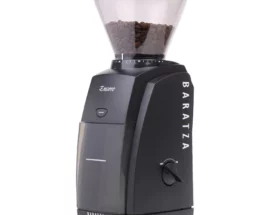
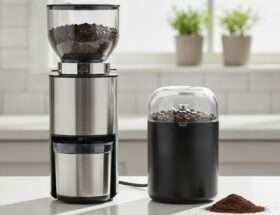
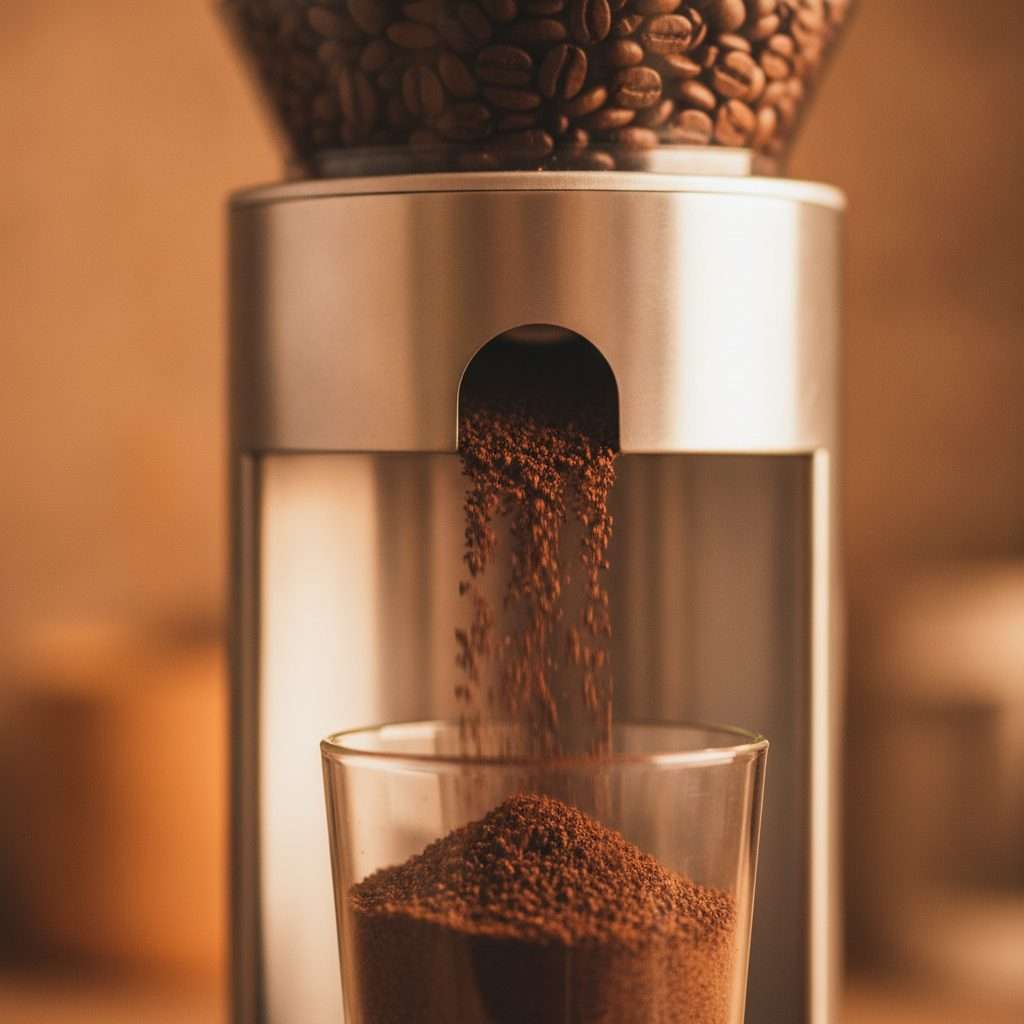
You can memorize this entire chart and still get burned if your grinder is bad. Here’s the deal. A blade grinder is basically a tiny propeller that smashes beans at random. A burr grinder crushes beans between two abrasive surfaces set a precise distance apart, so particle size is controlled and consistent.
Why does that matter? Because consistency is the whole point. Blade grinders spit out a chaotic mix of fine dust and big chunks. The dust over-extracts into bitterness while the boulders under-extract into sourness, all in the same cup. You get muddled, confused coffee no matter how perfect your technique.
| Feature | Burr Grinder | Blade Grinder |
|---|---|---|
| How it works | Crushes beans between two burrs | Chops beans with a spinning blade |
| Grind consistency | Uniform particle size | Mix of dust and chunks |
| Grind size control | Adjustable, repeatable settings | Guesswork (timed by feel) |
| Extraction | Even and predictable | Uneven; bitter and sour at once |
| Best for | Every method, especially espresso and pour-over | In a pinch; spices, honestly |
| Price | $$–$$$ | $ |
If you’re serious about any precision method, a burr grinder isn’t a luxury, it’s the price of entry. We break down the options in our burr vs blade deep dive and our roundup of the best coffee grinders. Spend here before you splurge anywhere else.
Common Grind Mistakes (and How to Fix Them)
- Grinding too far ahead. Ground coffee goes stale in minutes as it loses aromatics to the air. Grind right before you brew, every time. Whole beans, stored properly, hold their freshness far longer.
- Chasing bitter with a coarser grind blindly. Bitter usually means over-extraction, so coarser is often right, but check your water temp and brew time first. Change one variable at a time.
- Using the same grind for everything. The setting that nails your drip machine will choke your espresso and gush through your French press. Match the brewer.
- Ignoring the roast. Darker roasts are more brittle and grind finer at the same setting, while light roasts are denser. You may need to adjust when you switch beans.
- Trusting a blade grinder for espresso. Just don’t. The inconsistency makes a good shot nearly impossible.
Frequently Asked Questions
How do I know if my grind is too fine or too coarse?
Taste is your best meter. A bitter, harsh, mouth-drying cup usually means the grind is too fine (over-extracted), so go coarser. A sour, thin, weak cup means it’s too coarse (under-extracted), so go finer. Brew time is another clue: if your pour-over or espresso runs faster or slower than expected, your grind is likely off.
Can I use one grind size for all brewing methods?
Technically yes, practically no. A single medium grind will give you drinkable drip coffee but disappointing espresso, French press, and Turkish. Each method’s contact time demands a matching grind. An adjustable burr grinder lets you switch between methods in seconds, which is exactly why it’s worth the investment.
Does the roast level change my grind setting?
It can. Dark roasts are more brittle and tend to grind finer at the same setting, while denser light roasts grind coarser. When you switch beans, taste your first cup and adjust. Our guide to light, medium, and dark roasts explains the differences in depth.
Why does freshly ground coffee taste so much better?
Grinding exposes a huge amount of surface area, and the aromatic oils and gases that give coffee its flavor start escaping immediately. Within 15 to 30 minutes, much of that aroma is gone. Grinding right before you brew locks in the good stuff. Storing whole beans correctly between grinds keeps them fresher even longer.
Do I need to weigh my coffee, or is grind size enough?
Grind size and dose work together. Nailing the grind but eyeballing the amount means inconsistent cups day to day. A simple kitchen scale removes the guesswork, and a good set of coffee scales makes dialing in any method far faster and more repeatable.
Here’s the bottom line: grind is the dial that unlocks everything else you do. Print the chart, trust your taste buds, and adjust one notch at a time. Get this right and even your cheapest beans will start tasting like a splurge. Now go grind something delicious.