How to Dial In Your Espresso Grind for the Perfect Shot
So your shiny new espresso machine pulled a shot that tasted like sucking on a lemon dipped in regret. Been there. Before you start side-eyeing your machine like it owes you money, take a breath, because the fix is almost never the machine and almost always the grind. That’s the good news. Dialing in espresso is just a tidy little game of cause and effect, and once you learn the rules, you’ll be pulling shots that make your kitchen smell like a fancy cafe and taste even better.
Here’s what you’re walking away with: how to use grind size as your main lever, the shot time and ratio numbers that actually matter, and a dead-simple way to read whether your shot is under- or over-extracted so you know which way to turn the dial. No jargon dumps, no guesswork. Let’s get you a shot worth bragging about.
What “Dialing In” Actually Means
Dialing in is the process of adjusting your variables until espresso flows out at the right speed and tastes balanced, sweet, and full. The beautiful, slightly annoying truth is that every bag of beans is different. A bag roasted last Tuesday behaves differently than one from a month ago, and a dark roast pours differently than a light one. So you re-dial every time you crack open a fresh bag. It sounds like a chore, but it takes about three shots and a little patience.
The whole game runs on extraction. Push too little flavor out of the grounds and you get sour, thin, and salty. Push too much out and you get bitter, harsh, and ashy. Your job is to land in that happy middle where the coffee tastes like coffee is supposed to. If you want the full setup walkthrough first, our ultimate guide to making espresso at home covers gear and technique from the ground up.
The Three Numbers You Need to Memorize
You don’t need a chemistry degree. You need three targets. Tattoo these on your brain (or, fine, a sticky note on the cabinet).
- Dose (what goes in): For a standard double shot, aim for 18 to 20 grams of ground coffee in the basket. Most double baskets are built for roughly this range.
- Yield (what comes out): You want about double your dose in liquid espresso. So 18 grams in, around 36 grams out. That’s the famous 1:2 ratio.
- Shot time: That 1:2 shot should take 25 to 30 seconds to pull, measured from the moment you start the pump.
Notice that yield is measured in grams, not ounces or “until the cup looks right.” Volume lies because crema is mostly foam. Weight tells the truth, which is exactly why a small coffee scale is the cheapest upgrade you can make to your espresso game. Put the cup on the scale, tare to zero, and watch the numbers climb.
Grind Size Is the Boss
If you only adjust one thing, adjust your grind. It’s the most powerful lever you have, because it controls how fast water moves through the puck. Finer grounds pack tighter and slow the water down. Coarser grounds leave more gaps and let water race through.
- Shot pouring too fast (under 25 seconds, watery, gushing): Your grind is too coarse. Go finer to slow it down.
- Shot pouring too slow (over 30 seconds, dripping, choking): Your grind is too fine. Go coarser to speed it up.
Espresso lives and dies by grind consistency, and this is where a quality burr grinder earns its keep. Blade grinders produce a chaotic mix of dust and chunks that water can’t move through evenly, which makes dialing in nearly impossible. If your shots feel random no matter what you do, your grinder may be the culprit. A solid espresso-capable grinder with fine adjustment steps is the single best investment for repeatable shots.
How to Taste Your Shot Like a Pro
Numbers get you close. Your tongue gets you there. Memorize this cheat sheet and you’ll never be lost again.
Sour Means Under-Extracted
If your shot tastes sharp, sour, tangy, or weirdly salty, the water didn’t pull enough out of the grounds. It ran through too quickly. The fix: grind finer to slow the flow and extract more. Think of sour as the coffee saying, “you rushed me.”
Bitter Means Over-Extracted
If your shot tastes harsh, ashy, dry, or aggressively bitter, the water pulled out too much, including the nasty stuff that lives in the grounds. It sat there too long. The fix: grind coarser to speed up the flow and extract less.
The sweet spot tastes balanced and lightly sweet, with the bright and the deep notes holding hands instead of throwing punches. If you’re still chasing intensity once your shot is balanced, our guide on adjusting coffee strength helps you fine-tune from there.
The Step-by-Step Dial-In Routine
Here’s the actual workflow. The golden rule, and I mean it, is to change one variable at a time. Touch two things at once and you’ll never know which one fixed (or wrecked) the shot.
- Set your dose. Weigh 18 grams into the portafilter. Use the same number every single time so it’s not a moving target.
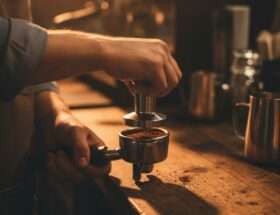
- Distribute and tamp. Level the grounds, then tamp with firm, even pressure. Consistency matters more than brute force, so tamp the same way each shot.
- Pull and time it. Put your cup on the scale, tare, start the shot, and start your timer together. Stop when you hit 36 grams in the cup.
- Check the clock. Did 36 grams take 25 to 30 seconds? If yes, taste it. If no, adjust grind: too fast means finer, too slow means coarser.
- Adjust one notch and repeat. Make a small grind change, pull again, and re-check. Two or three rounds usually gets you there.
- Taste and fine-tune. Once your time is in range, let your tongue make the final call. Sour, go finer. Bitter, go coarser.
Make tiny adjustments. Espresso grinders are sensitive, and one or two clicks can swing your shot time by several seconds. Resist the urge to crank the dial dramatically, or you’ll overshoot and start the whole dance over.
Common Mistakes That Sabotage Your Shots
- Changing everything at once. New grind, new dose, new tamp, all in one shot. Now nothing is diagnosable. Slow down.
- Eyeballing the yield. “It looks about right” is how inconsistency is born. Weigh it.
- Using stale beans. Coffee that’s weeks past roast loses the gases that build crema and balance. Buy fresh and store it well; our notes on storing coffee beans keep your stash from going flat.
- Inconsistent tamping. A wobbly or uneven tamp lets water channel through one side, ruining extraction no matter how perfect your grind is.
- Skipping the warm-up. A cold machine and cold portafilter drop your brew temperature, which should sit around 90 to 96 degrees Celsius (roughly 195 to 205 Fahrenheit). Let everything heat up before you pull.
Frequently Asked Questions
How long should a double espresso shot take?
Aim for 25 to 30 seconds to pull roughly 36 grams of espresso from an 18-gram dose. If it’s faster, grind finer; if it’s slower, grind coarser. Time is your first clue, but always confirm with a taste.
Why is my espresso sour?
Sour espresso is under-extracted, meaning water passed through too quickly and didn’t pull enough flavor. Grind finer to slow the flow and let the water extract more. Make sure your machine is fully heated, too, since low temperature also causes sourness.
What grind ratio should I use for espresso?
Start with a 1:2 brew ratio, which means your liquid yield should weigh about twice your dry dose. So 18 grams in, 36 grams out. You can stretch toward 1:2.5 for a longer, milder shot or tighten to 1:1.5 for a ristretto once you’re comfortable.
Do I really need a scale and a burr grinder?
For consistent espresso, yes. A scale removes guesswork from your dose and yield, and a burr grinder produces the uniform, finely adjustable grind espresso demands. They’re the two upgrades that make dialing in feel effortless instead of frustrating.
How often do I need to re-dial my grind?
Every time you switch to a new bag of beans, and sometimes as a single bag ages over a couple of weeks. Roast level, freshness, and even humidity shift how the coffee behaves, so a quick re-dial keeps your shots dialed in.
Go Pull a Great Shot
That’s the whole secret: weigh your dose, watch your time and yield, taste for sour or bitter, and turn the grind dial one small step at a time. Do that and you’ll go from accidental lemon water to a balanced, sweet, crema-topped shot faster than you’d think. Now go warm up that machine and treat yourself to the kind of espresso that makes leaving the house for coffee feel a little silly. You’ve got this, and your kitchen is about to smell amazing.