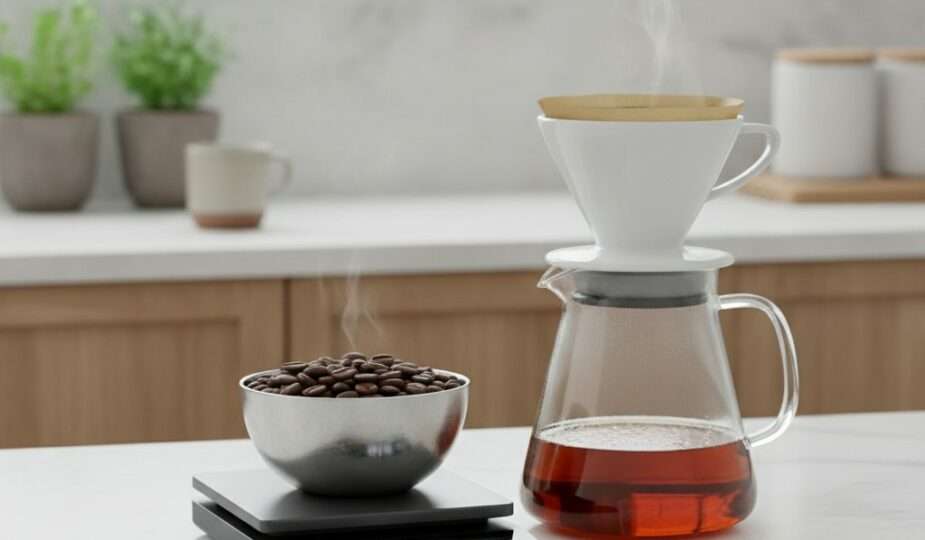
Coffee-to-Water Ratio: The Golden Ratio for Every Brew
You bought the fancy beans. You watched the barista videos. And your coffee still tastes like sad, weak dishwater (or, plot twist, battery acid). Before you blame the beans, the grinder, or Mercury in retrograde, let’s talk about the one number quietly running the whole show: your coffee-to-water ratio.
Get this right and everything else falls into line. By the end of this you’ll know the golden ratio, how to scale it to any cup using grams (yes, a tiny bit of math, I promise it’s painless), the exact ratio for every brew method from drip to cold brew, and how to nudge it when your cup tastes off. Let’s pour.
What Is the Golden Ratio for Coffee?
The “golden ratio” is the sweet spot between too much coffee and too little water (or vice versa). The Specialty Coffee Association pegs it at roughly 1:18 in its Golden Cup standard, which works out to about 55 grams of coffee per liter of water. In the real world, most home brewers live happily in the 1:15 to 1:18 range, depending on how bold they like it.
That ratio exists for a reason. It lands your brew inside the SCA’s target extraction window of 18-22% (how much of the coffee actually dissolves into your cup) and a total dissolved solids level of about 1.15-1.35%. Translation: balanced, sweet, and not at war with your taste buds.
Here’s the cheat code to reading these: the bigger the second number, the weaker and lighter the cup. 1:18 is delicate and tea-like. 1:12 is a punch in the face (the good kind). Pick your fighter based on the method and your mood.
Why Weighing Beats Scooping (Every Single Time)
I know, I know. The scoop is right there. It’s so easy. It’s also lying to you.
A “tablespoon of coffee” isn’t a real measurement, because coffee isn’t a fixed thing. A scoop of fluffy light-roast whole beans weighs differently than the same scoop of dense dark-roast, and finely ground coffee packs in tighter than a coarse grind. Volume changes with roast level and grind size; weight does not. Ten grams is ten grams whether it’s powder or pebbles.
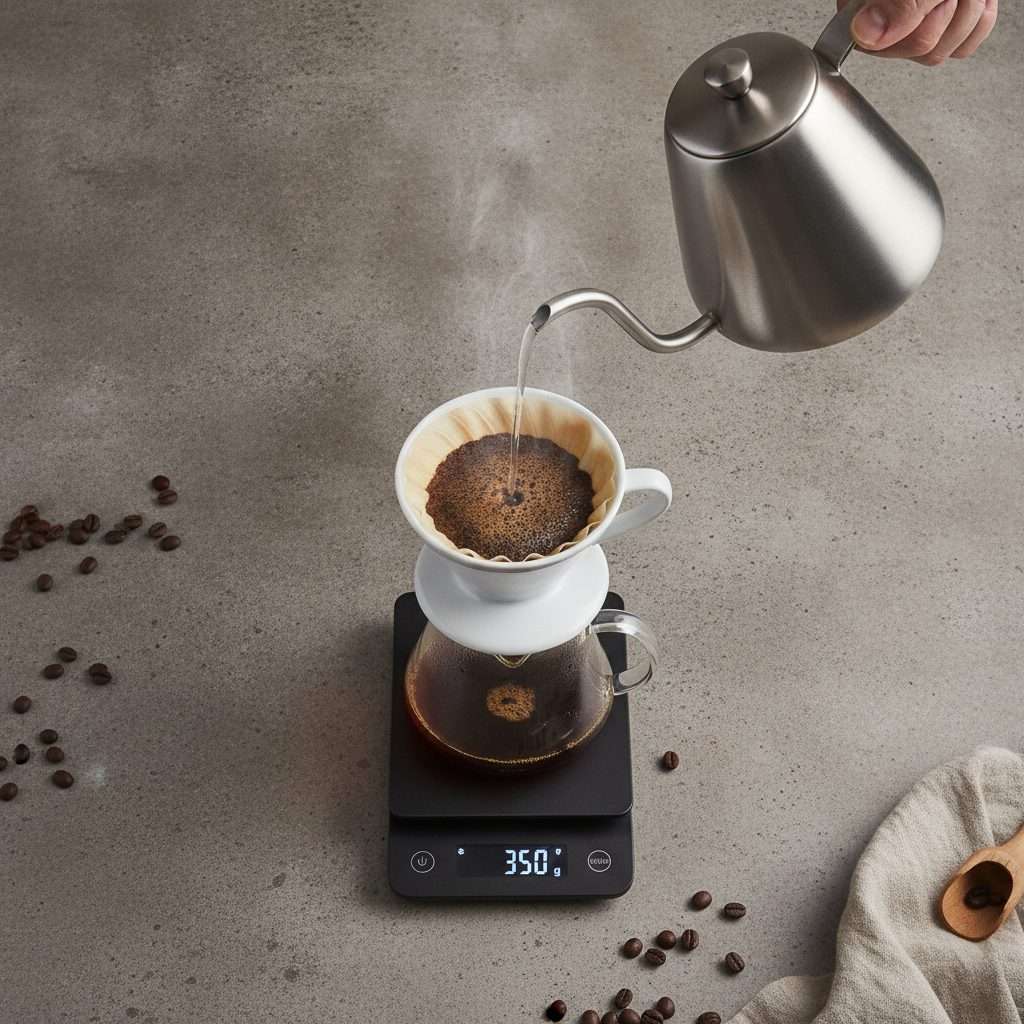
This is exactly why every serious brewer reaches for a coffee scale. A scale with 0.1-gram resolution turns “I think this is about right” into a recipe you can repeat tomorrow, next week, and the day your in-laws judge your hosting skills. Bonus: water weighs beautifully too. One gram of water equals one milliliter, so your scale handles both sides of the ratio.
- Scooping: fast, but wildly inconsistent. Same scoop can swing your dose by 2-4 grams.
- Weighing: repeatable, dial-in-able, and the only way to truly troubleshoot a bad cup.
How to Scale Any Ratio by Grams
Here’s the only math you need, and it’s middle-school easy. Pick your water amount, then divide by the second number in the ratio to get your coffee dose.
- Coffee dose = Water ÷ ratio number. Want 500 g of water at 1:16? That’s 500 ÷ 16 = ~31 g of coffee.
- Water amount = Coffee × ratio number. Got 20 g of coffee and want 1:15? That’s 20 × 15 = 300 g of water.
A standard mug holds around 350 ml (350 g) of water. At 1:16 that’s about 22 g of coffee. Brewing a full 1-liter carafe at 1:16? You’re looking at roughly 62 g. Memorize one number you brew often and the rest becomes muscle memory.
Coffee-to-Water Ratio Chart by Brew Method
Different methods want different ratios because they extract differently. Immersion brews (where grounds soak) and concentrates lean stronger; clean filter brews lean lighter. Here’s your quick-reference table, plus how much coffee that means for a standard cup.
| Brew Method | Golden Ratio | Coffee per 350 ml cup | Notes |
|---|---|---|---|
| Drip / Auto Machine | 1:16 | ~22 g | Reliable everyday balance |
| Pour-Over | 1:16 | ~22 g | 1:15 for bolder, 1:17 for bright |
| French Press | 1:12 – 1:15 | ~25-29 g | Immersion = stronger, fuller body |
| Espresso | 1:2 | 18 g in, ~36 g out* | Ratio is dose to liquid yield |
| Cold Brew (concentrate) | 1:8 | Dilute before drinking | Cut 1:1 with water or milk |
| Cold Brew (ready-to-drink) | 1:15 | ~23 g | No dilution needed |
Drip and Pour-Over: 1:16
For both your automatic drip machine and a hand-poured cone, 1:16 is your home base. It’s the Goldilocks zone for clean, balanced filter coffee. Nail your pour-over technique with a medium grind and water around 200°F, and 1:16 will reward you. Like it punchier? Slide to 1:15. Want more clarity and tea-like brightness? Drift to 1:17.
French Press: 1:12 to 1:15
The French press is a full-immersion method, so the grounds steep in the water the whole time. That builds a richer, heavier body, and it loves a stronger ratio. Start at 1:15 if you’re new, then creep toward 1:12 if you want that velvety, almost chewy cup. Our full French press guide walks through the four-minute steep and the all-important coarse grind that keeps sludge out of your mug.
Espresso: 1:2 (the Brew Ratio)
Espresso plays by its own rules. Here the ratio compares the dry coffee dose to the weight of liquid espresso pulled, not a mug of water. A classic modern shot is 1:2: about 18 g of grounds yielding roughly 36 g of espresso. Tighter ratios like 1:1.5 (a “ristretto”) taste syrupy and intense; longer ones like 1:3 (“lungo”) run lighter and more bitter. If espresso is your thing, learning to dial in your grind and reading our home espresso guide will pay off fast.
Cold Brew: 1:8 Concentrate
Cold brew is the strong, silent type. Steep coarse grounds in cold water for 14-20 hours at a beefy 1:8 ratio and you get a concentrate, not a finished drink. Dilute it before sipping: a 1:1 split with water or milk gives you smooth, sweet, ready-to-go cold brew. Prefer to skip the dilution dance? Brew at 1:15 from the start for a ready-to-drink batch.
How to Adjust Your Ratio to Taste
Ratios are a starting line, not a prison. Your beans, roast, and grinder all have opinions. Use this quick troubleshooting guide to read your cup and fix it.
| Your cup tastes… | Likely problem | The fix |
|---|---|---|
| Weak, watery, thin | Too much water (under-dosed) | Add coffee: shift toward 1:15 or 1:14 |
| Sour, sharp, grassy | Under-extracted | Grind finer or brew slightly longer |
| Bitter, harsh, drying | Over-extracted | Grind coarser; add a touch more water |
| Strong but harsh | Too much coffee | Back off toward 1:17 or 1:18 |
The golden rule of adjusting: change one variable at a time. If you tweak ratio, grind, and water temp all at once, you’ll never know what actually moved the needle. Shift your ratio by a single number, taste, and decide from there. For a deeper dive, our guide on adjusting coffee strength breaks down every lever you can pull.
One more thing the ratio can’t fix on its own: bad water and bad grind. Roughly 98% of your cup is water, so water quality matters enormously, and an uneven grind from a quality burr grinder versus a blade chopper changes everything. Dial those in alongside your ratio and you’re cooking with gas.
Common Coffee Ratio Mistakes
- Eyeballing the dose. Scoops lie. Weigh both coffee and water.
- Forgetting to tare the scale. Zero out your mug or carafe before adding coffee, then re-tare before pouring water.
- Mixing up ratios and methods. A French press ratio in a drip machine makes a brutal cup. Match the ratio to the brewer.
- Drinking cold brew concentrate straight. That 1:8 brew is meant to be cut. Respect it.
- Chasing strength with ratio when grind is the culprit. Sour or bitter usually means extraction, not dose.
Frequently Asked Questions
What is the best coffee-to-water ratio for beginners?
Start at 1:16 for drip or pour-over. It’s the most forgiving, balanced ratio and a great baseline to taste from. Once you know how 1:16 lands for you, adjust up or down a single number to suit your palate.
How much coffee do I use for one cup?
For a standard 350 ml mug at 1:16, use about 22 grams of coffee. For a smaller 240 ml cup, drop to around 15 grams. Just divide your water weight by 16 and you’ve got your dose.
Do I really need a scale to brew good coffee?
You can make decent coffee without one, but you can’t make consistent coffee without one. A scale is the single best upgrade for repeatable results, because volume measures betray you across roasts and grinds while weight never does.
Why does my coffee taste bitter even at the right ratio?
Bitterness usually points to over-extraction, not too much coffee. Try a coarser grind, slightly cooler water (around 195-200°F), or a shorter brew time before touching your ratio. Stale beans and an uneven grind are common culprits too.
Is the golden ratio the same for light and dark roasts?
Roughly, yes, but light roasts are denser and extract more slowly, so many brewers nudge toward 1:15-1:16 for them and 1:16-1:17 for darker, easier-extracting roasts. Pick your beans, start at the golden ratio, and fine-tune from there.
That’s the whole game: weigh your coffee, weigh your water, match the ratio to your method, and taste your way to perfect. Start at the golden ratio tomorrow morning, keep a little brew log if you’re feeling fancy, and watch your cups get noticeably better. Your future, more-caffeinated, very-pleased self says thanks.